Labradorite gemstone meaning centers on protection during times of change—helping us reconnect with our intuition, recognize our inner strength, and move through transformation with greater courage and clarity.
What Is Labradorite?
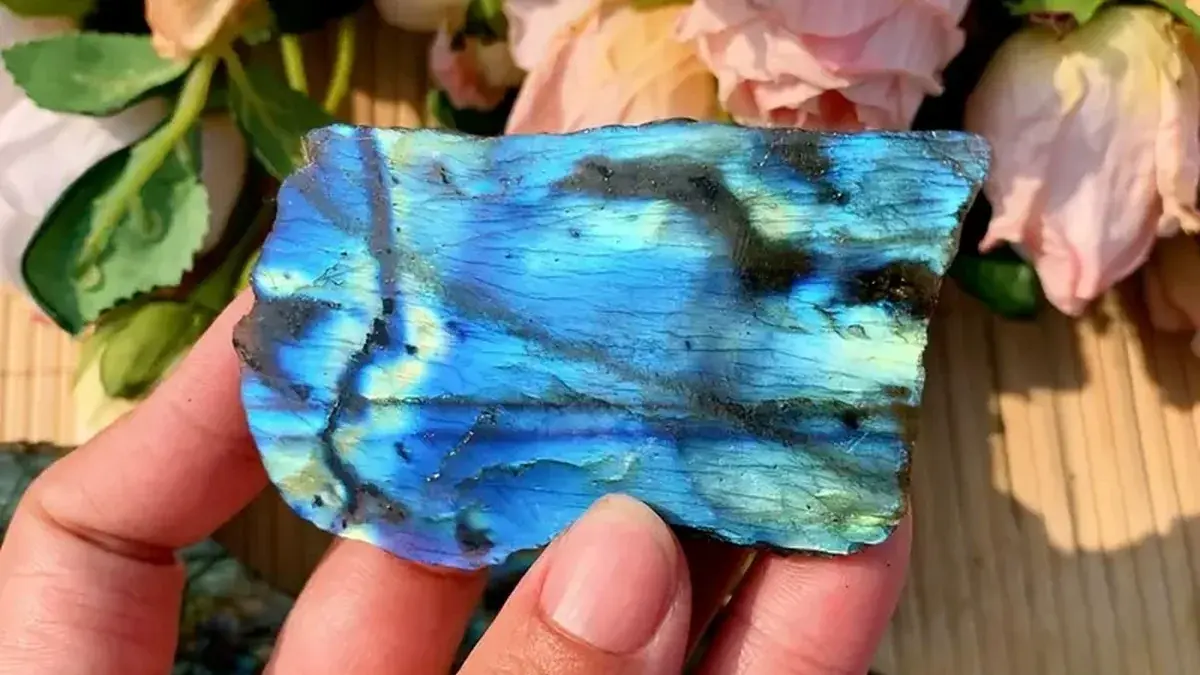
Normally , the Labradorite stone may seem quiet and understated. The body is often gray, smoky, colorless, or dark-toned.but if you change the viewing angle changes the shades of blue, green, gold, orange, red, or violet may suddenly appear. thats is the magical of labradorite stone .
Your Attractive Heading Labradorite is a feldspar mineral known for the brilliant flashes of color that appear when it moves beneath the light.
This optical effect is known as labradorescence. Because its colors reveal themselves only under the right light and at the right angle, labradorite has become a natural symbol of hidden potential.
Its appearance reminds us that a person or situation may contain far more than can be seen at first. This is why the stone is often associated with turning points, new perspectives, and personal transformation.
Where to find labradorite?
The name labradorite comes from Labrador, Canada, where the mineral was first formally recorded on Paul Island near the community of Nain. It is sometimes described as “Labrador stone,” although labradorite is its accepted mineral name.
High-quality iridescent material has since been found in several parts of the world. Canada, Finland, and Madagascar are particularly well known for producing labradorite with remarkable flashes of color. Other occurrences have been documented in the United States and many additional geological regions.
When properly oriented and polished, exceptional labradorite can resemble the shimmering surface of a butterfly’s wing. Larger carvings made from strongly labradorescent stone can be uncommon because the artist must position the design at precisely the right angle to reveal the hidden color.
The Butterfly Goddess and the Stone of Transformation
Beyond its geological origins, labradorite has inspired a modern allegory in contemporary crystal culture.
The story tells of a Butterfly Goddess who guided thousands of butterflies across forests, mountains, and open water during their seasonal migration. She helped them find places to rest before continuing toward a new home.
The goddess was said to possess a thousand masks, allowing her to take the form of many living beings. Wherever she and the butterflies rested, fragments of their iridescent wings fell upon the earth. Over time, those fragments became stones filled with blue, green, gold, and violet light.
According to the allegory, anyone who found one of these stones received the goddess’s blessing: protection for the journey ahead, courage in the face of change, and the wisdom to recognize when it was time to move forward.
Although this is a modern symbolic story rather than a documented historical legend, it reflects the qualities commonly associated with labradorite: transformation, protection, intuition, and trust in the path ahead.

What causes the brilliant glow in flashy labradorite?
Labradorite’s remarkable color does not come from a surface coating or pigment.
Light enters the stone and interacts with extremely fine internal layers formed by feldspars of slightly different compositions. These alternating structures develop as the mineral cools.
When light reaches these layers, certain wavelengths are reflected, scattered, and intensified. The colors we perceive depend on the thickness and orientation of the internal structures, as well as the angle between the stone, the light source, and the observer.
As the stone moves, the angle changes, allowing previously hidden colors to become visible. This phenomenon is called labradorescence.
The science behind this effect also supports the stone’s symbolism. Labradorite does not create light from darkness. It reveals light that was already present but could not be seen from the previous angle.
Labradorite Properties
The following labradorite properties describe the stone from a mineralogical perspective:
- Mineral group: Plagioclase feldspar
- Chemical composition: (Ca,Na)(Al,Si)₄O₈
- Crystal system: Triclinic
- labradorite mohs scale: 6–6.5
- Cleavage: Two directions of perfect cleavage
- Typical body color: Colorless, white, gray, pale green, or bluish
- Iridescent colors: Blue, green, yellow, gold, orange, red, and violet
- Transparency: Transparent to translucent
- Notable sources: Canada, Finland, Madagascar, and the United States
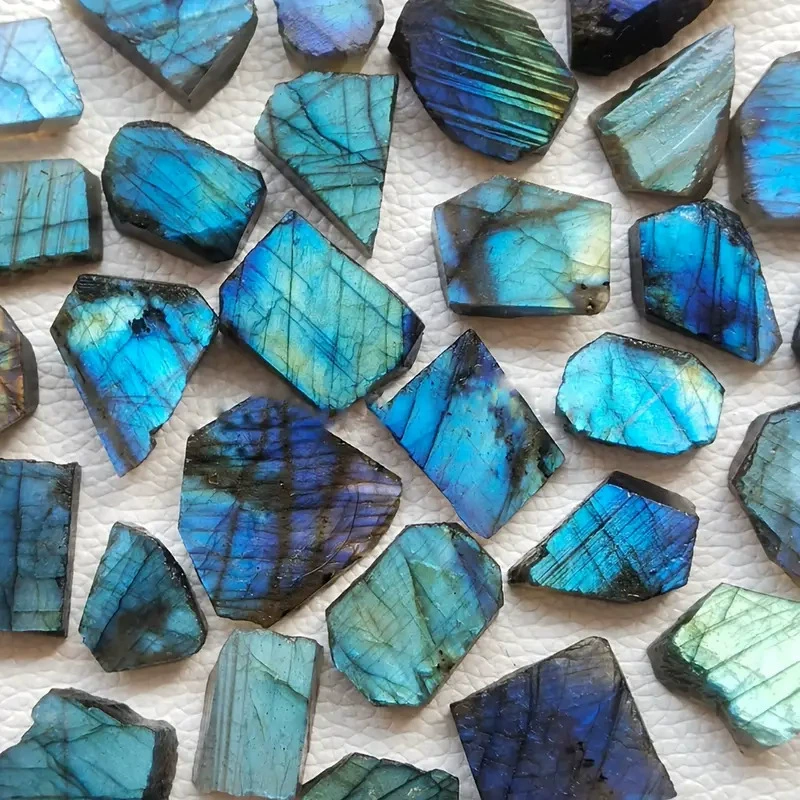
Not every specimen displays the same intensity of color. Its appearance depends on the stone’s internal structure, the orientation of the rough material, and the way it has been cut and polished.
Two stones from the same source can therefore look very different. One may reveal a concentrated blue flash, while another displays several colors across its surface.
This natural variation is part of labradorite’s appeal: every piece reveals its hidden light in its own way.
What Does Labradorite Symbolize?
The symbolism of labradorite is closely connected to the contrast between its quiet surface and its unexpected color.
It is commonly associated with:
- Transformation
- Protection
- Intuition
- Inner strength
- Creativity
- Self-discovery
- New beginnings
- Hidden potential
The appearance of the stone suggests that growth does not always happen where others can see it. A person may be developing courage, clarity, or a new sense of direction long before those changes become visible.
This is the deeper message behind labradorite crystal meaning: there may be more light within us than we currently recognize.
Labradorite does not need to be interpreted as a magical solution. It can instead serve as the labradorite symbolism of our willingness to change, trust ourselves, and remain open to possibilities that have not yet fully appeared.
The Symbolic Energy of Labradorite
In modern crystal culture, the symbolic energy of labradorite is most closely associated with transformation, protection, and intuition.
Its changing colors make it a meaningful stone for periods of transition. They remind us that uncertainty may contain possibilities we have not yet recognized.
Labradorite is also traditionally connected with energetic protection and personal boundaries. Some people wear or keep it nearby as a symbolic reminder to stay connected to their values and inner direction.
These ideas help explain labradorite benefits and labradorite metaphysical properties in contemporary crystal traditions. They are spiritual and symbolic interpretations rather than scientifically established medical effects.
Detailed discussions of chakras, meditation, cleansing practices, and spiritual uses can be explored separately in a dedicated guide to labradorite energy.
Labradorite and the Chinese Five Elements
From a contemporary Chinese Five Elements perspective, labradorite is primarily associated with Fire and secondarily with Earth.
Fire is reflected in the brilliant colors that suddenly emerge when the stone moves beneath the light. It represents illumination, courage, expression, action, and transformation. Labradorite’s shifting flash can therefore symbolize the moment when hidden potential becomes visible.
Earth is expressed through the stone’s quieter physical form. Beneath its changing colors, labradorite often has a grounded gray or dark-toned body. Earth represents stability, protection, patience, and the inner foundation needed to move safely through change.
Together, Fire and Earth create a meaningful balance. Fire inspires transformation, while Earth provides the stability needed to sustain it. Fire encourages movement; Earth helps us remain connected to ourselves.
Labradorite can therefore be understood as “Fire held within Earth”—hidden light resting inside a solid stone.
This interpretation reflects labradorite meaning particularly well: protection during uncertainty, courage in the face of transformation, and the discovery of strength that was already present beneath the surface.

How Is Labradorite Used?
Labradorite may be worn, held during meditation, displayed in a personal space, or kept as a symbolic object during periods of reflection and change.
So, what is labradorite good for? In modern crystal practices, it is commonly associated with personal reflection, creativity, new beginnings, emotional boundaries, and learning to trust one’s intuition.
There is no single correct way to use labradorite. Its meaning comes from the personal intention connected to it.if you want to know how to use labradorite and get more details about the labradorite crtstal healing , please find our anther artifical :Labradorite Benefits and Healing Properties: Energy, Protection, and Uses
Detailed meditation methods, wearing practices, spiritual cleansing traditions, and other uses will be covered in a separate guide.
A Final Reflection
Labradorite teaches its lesson through light.
From one angle, it may appear quiet and unremarkable. From another, it suddenly reveals colors that were present all along. Its beauty depends on movement, perspective, and the willingness to look again.
Whether appreciated as a geological wonder or used as a symbol of personal growth, labradorite reminds us that uncertainty does not necessarily mean the absence of direction.
Sometimes it is simply the space in which a new light is preparing to appear.